
a.k.a. still running out of cute punny rhymes.
Candle Arc progress
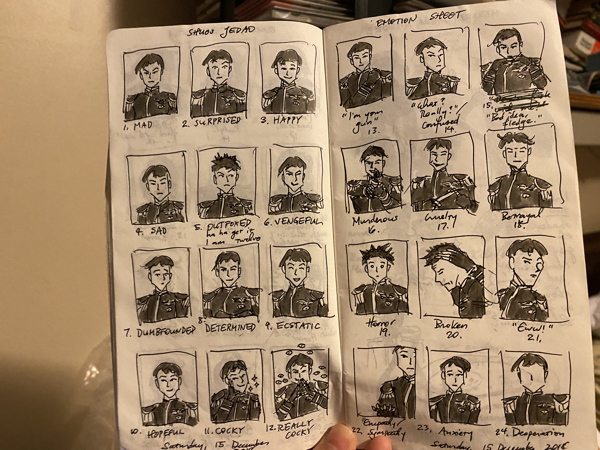
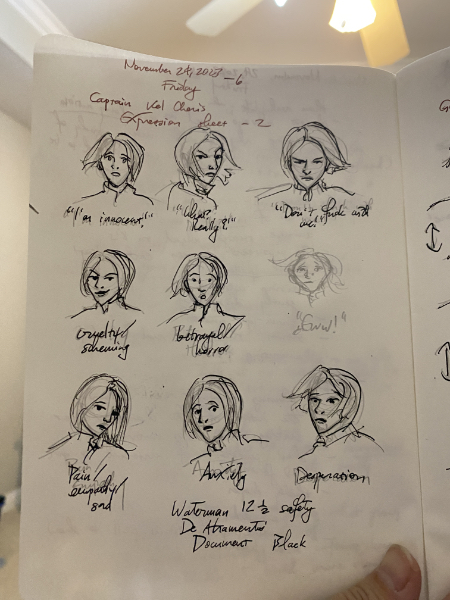
I’m in early production now, working on the Act One animatic for timing. I hired two voice actors for Candle Arc, who are terrific, and of whom I will say more when I have more done on my end.
I expect anyone glancing at this already knows, but here’s a breezy overview of what the 2D animation process looks like for DIY student indie mode (long):
Pre-production
Script, concepts and designs, storyboards. This part is done.

Production
Record dialogue and voiceover
You need this early because animating lip sync depends on the timing of the vocals.
Process dialogue
Effects like de-essers (to make “s” sounds less “hissy”), reverb, editing takes, finalizing the timing.
Animatic
This is a “slideshow” to nail down the timing before committing to “real” animation. Doing this digitally means it’s trivial to extend or shorten individual “slideshow” frames to adjust the timing until it feels right!
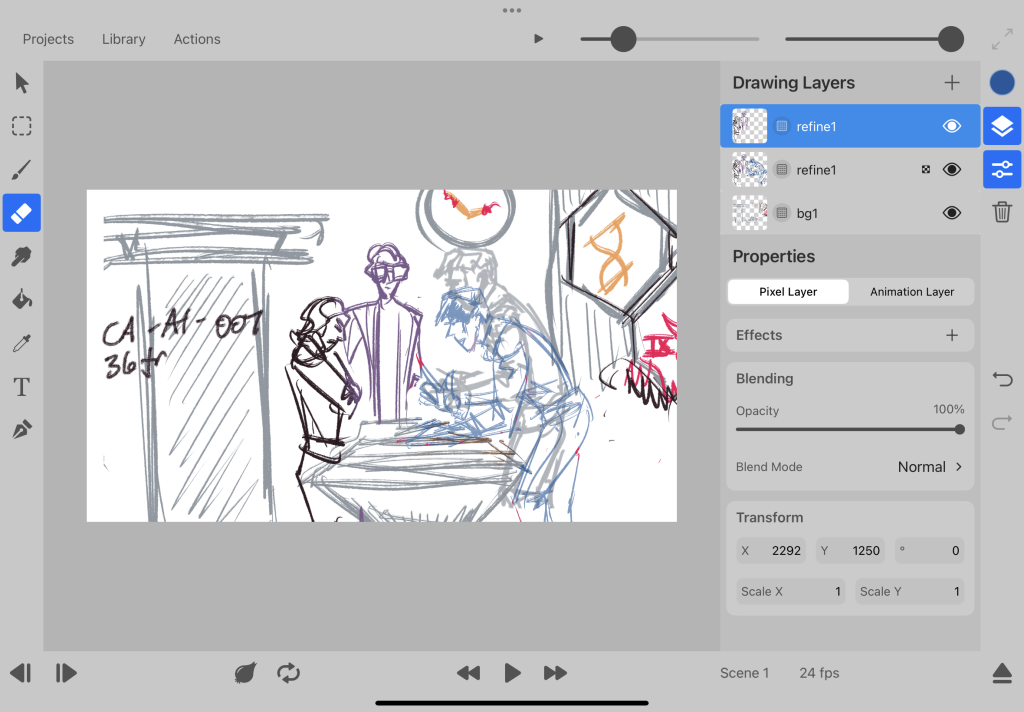
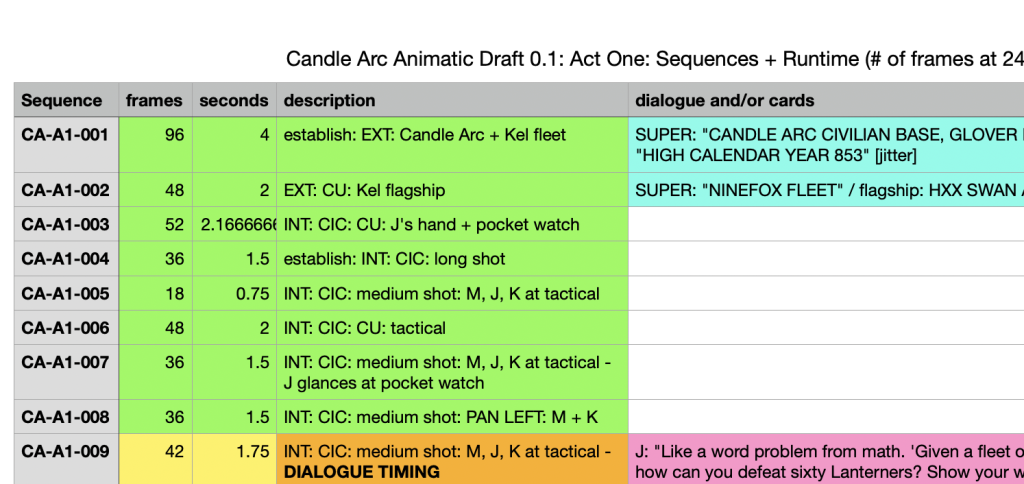
I’m dividing the animatic into separate files for the sequences. I have a spreadsheet to track this.
Pencil test
“Actual” animation, but we’re “just” doing the lineart.
Colors
I’m using tinted lines rather than full cel shading. Cel shading is beautiful, but it’s tricky to do well. It’s more important that the visual style communicate the story than that it be fully rendered.

Post-production
Editing and compositing in a video editing app.
Sound design and effects are added after the picture is locked.
Scoring (the “real” goal for me as far as my MFA is concerned!) happens after everything else is locked. This includes spotting: determining the major “hit points” that need to be addressed by the music (including “LET’S NOT HAVE MUSIC IN THIS SCENE”).
Mixing/mastering: the dialogue, SFX, and score have to work in tandem. A lot of mixing is best handled at the level of composition and arrangement, e.g. if you have an important soliloquy by a soprano actor, don’t also put strident flutes and violins in the score in the same frequency range.
This will be a wild amount of work, but I am making progress and having a great time.
Other divertissements
Current listening
- Starship Alexandria, a podcast by sf/f authors Emma Newman and Adrian Tchaikovsky! Discussions of sf/f books and media, an absolute balm.
- Katee Sackhoff [Starbuck] watches Battlestar Galactica for the first time [YouTube]. A delight, especially the banter between herself and her husband.
- Heilung. Lots and lots of Heilung.
Current gaming & game design
- Balatro, the perennial comfort game.
- Phantom Force, a small-unit tactics game. It makes me think (complimentary) of M.A.X. (Mechanized Assault and eXploration) and Superhot, except without the 4X of M.A.X. or the FPS slant of Superhot.
Currently reading & recently read
- Alex de Campi & Erica Henderson’s Dracula, Motherf**er! Striking and sinister (and yes, the asterisks are part of the title). Graphic novel.
Recent watching
- Masters of the Universe: Revelation and Masters of the Universe: Revolution. My husband and I inhaled these. I came for the Bear McCreary score (and loved She-Ra in Korean dub as a child) but the story is a glorious subversive (complimentary) emotional roller coaster. I don’t think I’ve seen an example of that particular thematic configuration since Lloyd Alexander’s Westmark trilogy (complimentary)!
I’ve been buried beneath family commitments and dental work (fortunately, I also have the world’s nicest dentist) but here’s to better times for us all.
Yours in calendrical heresy,
YHL
Leave a Reply